Can You Have Fun on a Grief Retreat?

Can you have fun on a grief retreat? Yes, and it's not a contradiction. Grief and joy are not opposites competing for the same limited space. They coexist, sometimes within the same hour, and a retreat that only made room for tears wouldn't be an honest reflection of what grief actually feels like day to day.
Why the guilt shows up first
For most people, the discomfort isn't really about whether fun is possible. It's about what it might mean if it happens. If you laugh at dinner, has some part of you stopped missing the person you lost? If a walk through the Douro Valley or an afternoon by a private pool in the Maldives feels genuinely good, does that good feeling betray the seriousness of your grief, or the person it belongs to? This worry is common enough to have a name in the grief literature: some researchers describe it as a kind of loyalty conflict, the sense that ongoing attachment to someone who died requires ongoing visible suffering, as though joy were evidence that the bond has weakened.
It hasn't. Missing someone and briefly forgetting to miss them for the length of a good conversation are not in competition. One doesn't cancel the other out.
Grief and joy were never opposites
Grief researchers who study bereavement directly have looked at exactly this question, and the findings consistently point the same direction. In studies of recently bereaved spouses, moments of genuine humor, laughter, and happiness in the weeks and months after a death were associated with better adjustment over time, not worse, and with stronger connection to the people around them, not weaker. Psychologist George Bonanno's research on bereavement found something similar: people who showed real, spontaneous laughter while talking about their loss tended to be coping more effectively over the following years than those who didn't, not less effectively. Positive emotion during grief isn't a sign that someone is avoiding their pain. Often it's a sign that they have enough capacity left to feel something else too, which is itself a kind of resilience.
None of this means forcing yourself to feel cheerful, or treating a retreat as an escape from grief. It isn't that either. It means the presence of a genuine laugh at dinner doesn't need to be interrogated or apologized for. It can just be what it is.
Why it's easier in the right company
The guilt around joy is rarely constant. It tends to spike in front of certain audiences: people who might think you've moved on too fast, people who are still expecting you to be visibly devastated, people whose own discomfort with your grief has quietly trained you to perform sadness for their benefit. A room full of people who are also grieving doesn't come with that pressure. Everyone there understands, from direct experience, that a good laugh over a shared meal an hour after a hard conversation about someone's dad isn't a contradiction. It's just what a real week of grieving looks like when nobody's pretending.
That's part of what a shared trip, rather than a solo one, can offer that grieving alone often can't. Nobody at the table has to explain why they're suddenly laughing at something absurd, or why they went quiet ten minutes later. Both are just allowed to happen, back to back, without either one needing to be managed for someone else's comfort.
What a good day actually looks like
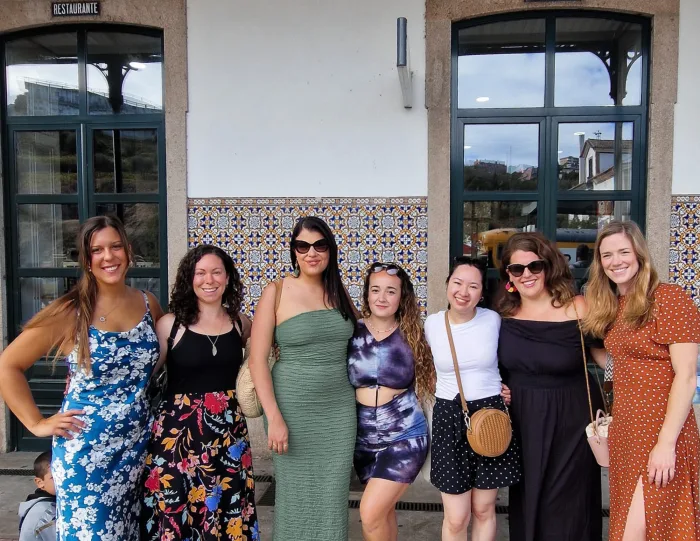
On a Grief Trips retreat, a single day might include a facilitated group conversation that leaves everyone a little raw, followed by a long lunch, a swim, or a walk through a souk that has nothing to do with grief at all and is simply enjoyable. That's not the retreat failing to stay on theme. It's closer to what grief researchers mean when they describe healthy adaptation to loss: the ability to move between confronting the loss directly and stepping into ordinary life, rather than being stuck permanently in either one.
There's also something to be said for the destination itself. Waking up somewhere genuinely beautiful, whether that's the Douro Valley, the Agafay Desert outside Marrakech, or a private villa on Goidhoo Island in the Maldives, doesn't erase why you're there. But it does make room for moments of real pleasure alongside the grief work, and those moments tend to matter more than people expect going in.
What this isn't
None of this is a claim that a retreat will make grief feel good, or that fun is the goal. It isn't a wellness holiday dressed up in grief language, and nobody is being nudged toward positivity or told to look on the bright side. The workshops are real, the conversations can be genuinely hard, and some days will simply be heavy from morning to night. The point isn't to balance the scales, so many minutes of sadness offset by so many minutes of enjoyment. It's closer to acknowledging that a whole person is more than their grief, even in the middle of the worst of it, and that a week which only allowed for one register of feeling would be a strange, narrowed version of what the week is actually for.
Grief Trips builds its retreats around exactly that balance: structured space to grieve honestly, and enough unstructured time, good food, and genuinely good company for joy to show up on its own terms, uninvited and unapologized for.
Curious what a grief trip is actually like?
Small-group grief retreats in Portugal, Morocco, and the Maldives. No pressure, applying just starts a conversation.
Join a Grief Trip ›You might also like

Why a Grief Trip Might Be the Most Powerful Thing You Do for Your Grief
A grief trip will not fix your grief, but it can do something everyday life rarely does: give you a small group retreat where you are met exactly as you are, dedicated space to feel, and unexpected laughter alongside the sorrow.

The Art of Letting Go of Resistance: Grief Workshop in Porto
During a grief workshop in Porto, Rachel discovered that fighting her emotions was exhausting her more than the emotions themselves. Letting go of resistance, and picking up a paintbrush, changed everything.
What Does Diversity Add to Grief Trips?
People often join a grief trip expecting connection with others who share their exact loss. What they find is something wider: perspective from grief that looks nothing like their own, and the quiet relief of no longer carrying it entirely alone.