Is Joining a Grief Retreat "Giving Up"?

Is joining a grief retreat "giving up"? No. It's closer to the opposite. Choosing structured support for grief takes more engagement with what's happened, not less, than gritting your teeth and hoping time quietly resolves it on its own. Nobody signs up for a retreat because they've given up on their grief. Most sign up because they haven't stopped carrying it, and they're ready to stop carrying it alone.
Where this fear comes from
The idea that asking for help means you're not coping doesn't come from nowhere. Most of us grew up around some version of the same message: be strong, keep busy, don't make a scene of it. Grief in particular gets wrapped in language borrowed from endurance: getting through it, powering through, staying strong for the kids. In that framing, strength means containment. The person who cries quietly in private and still shows up to work smiling gets held up as admirable. The person who says out loud that they're struggling, or who takes a week specifically to sit with their grief, can start to feel like they've failed some invisible test of resilience.
That test was never a fair one. It measures how well someone hides pain, not how well they're actually doing with it. A lot of people carry real damage from passing it anyway.
What "coping" is often assumed to mean
There's an old idea that healthy grieving looks like moving through a fixed sequence of stages and coming out the other side "over it." Most grief researchers have moved away from that model, because it doesn't match how grief actually behaves. A more widely used framework, the dual process model developed by researchers Margaret Stroebe and Henk Schut, describes grieving as an oscillation: moving back and forth between confronting the loss directly and attending to ordinary life, rather than climbing steadily toward some finish line. Both sides of that oscillation are considered a normal, necessary part of adapting to loss. Neither one is giving in.
What tends to complicate grief and prolong suffering isn't spending too much time attending to a loss. It's avoidance: pushing grief away entirely, staying too busy to feel it, treating any acknowledgment of pain as a threat to be managed rather than something to be lived through. If anything, the instinct to avoid support altogether is the pattern more associated with getting stuck, not the instinct to go looking for it.
Who actually books a retreat
People who show up to a grief retreat are, almost by definition, the ones doing something about their grief rather than around it. They've noticed something isn't settling on its own. They've thought about what they need and gone looking for it, which is a more demanding, more self-aware act than simply enduring. Some have been managing fine in most areas of life and want a dedicated space to finally feel what they've been holding at arm's length. Others feel like they haven't cried properly since the funeral and want somewhere it's allowed. Neither is a sign of weakness. Both are signs of someone paying attention to themselves.
It's also worth saying plainly: a retreat isn't a last resort reserved for people in crisis. Most people who join haven't hit some kind of breaking point. They're simply choosing to be intentional about something that would otherwise be left to chance.
What other people might say
Sometimes the fear isn't really about giving up internally. It's about how it will look to other people. A parent who says "we just got on with it in my day." A friend who seems mildly alarmed that you're spending money and time on something so specifically about your grief, as though naming it out loud makes it more serious than it already is. None of that reaction is really about you. It's usually about their own discomfort with loss, or their own unexamined belief that grief is something to be managed quietly and privately. Their comfort with how you grieve isn't a reliable measure of whether what you're doing is right for you.
Strength was never the absence of feeling
If there's a single idea worth letting go of, it's that strength and grief are opposites. They aren't. The people who arrive at a Grief Trips retreat are often the ones who have kept everything running for months, who have shown up for other people's needs while quietly falling apart, who are, by any reasonable measure, already strong. What they're looking for isn't permission to be weak. It's a few days where the strength they've been using to hold everything together can rest, and something else can happen instead.
Grief Trips runs small-group retreats of roughly eight to twelve people in Portugal, Morocco, and the Maldives, built around daily grief workshops, one-to-one support, and enough unstructured time to simply exist somewhere worth being. Nobody there had to prove they'd hit rock bottom to earn a place. They just decided their grief was worth paying real attention to, and that's not giving up on anything.
Curious what a grief trip is actually like?
Small-group grief retreats in Portugal, Morocco, and the Maldives. No pressure, applying just starts a conversation.
Join a Grief Trip ›You might also like

Why a Grief Trip Might Be the Most Powerful Thing You Do for Your Grief
A grief trip will not fix your grief, but it can do something everyday life rarely does: give you a small group retreat where you are met exactly as you are, dedicated space to feel, and unexpected laughter alongside the sorrow.

The Art of Letting Go of Resistance: Grief Workshop in Porto
During a grief workshop in Porto, Rachel discovered that fighting her emotions was exhausting her more than the emotions themselves. Letting go of resistance, and picking up a paintbrush, changed everything.
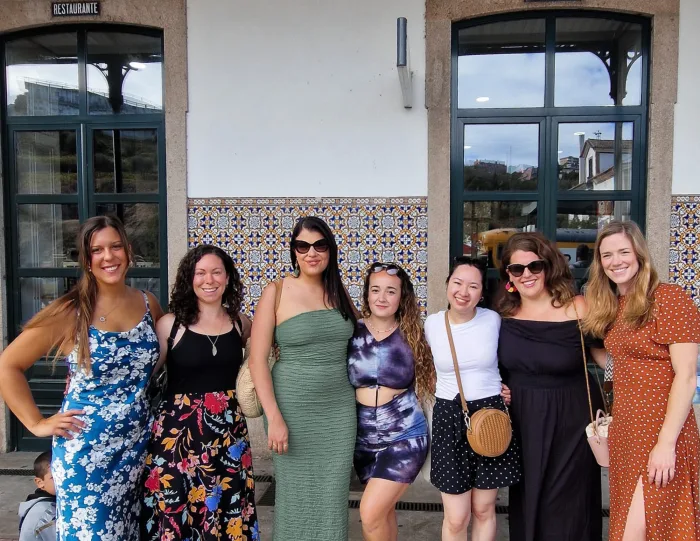
What Does Diversity Add to Grief Trips?
People often join a grief trip expecting connection with others who share their exact loss. What they find is something wider: perspective from grief that looks nothing like their own, and the quiet relief of no longer carrying it entirely alone.